
Build Your Dream Home with India's #1
Independent House Construction Company
Delivered in Just 8 Months
No Hidden Costs • 470+ Quality Inspections • Stage-Wise Payments
Our 6-Step Home Construction Process
Understand how we plan, design, and build your home with complete transparency and expert construction project management.
470+ Quality Checks for Homes We Build
At Brick & Bolt, quality is built into every stage of construction. Our engineers perform 470+ quality inspections across foundation, structure, masonry, electrical, and finishing to ensure your home is built to the highest standards.
Setting New Standards in Home Construction
Honored for innovation, trust, and excellence by some of the most respected names in the industry.
Why Homeowners Trust Brick & Bolt?
Every home has a story. Explore real journeys of families who trusted Brick & Bolt to build their dream homes with care, quality, and commitment.

🌟🌟🌟🌟🌟
Building a house in our favourite locality, with our own ideas and premium construction quality, was always a dream and Brick & Bolt helped us turn that dream into reality

🌟🌟🌟🌟🌟
After meeting a lot of contractors a friend of mine told me about Brick & Bolt, and I’m so glad I listened. They made everything simple and transparent, and now, I’m very happy to call this place my home.

🌟🌟🌟🌟🌟
After a Lifetime of service, we needed someone we could rely on-and we found them!
What Makes Brick & Bolt Different from Local Contractors?
Don’t risk delays, hidden costs, or poor quality. With Brick & Bolt, you get complete transparency, guaranteed quality checks, and full control over your home construction journey.
| Parameter | Brick & Bolt | Local Contractors |
|---|---|---|
| App-Based Project Tracking | ✅ | ❌ |
| Escrow Money Safety | ✅ | ❌ |
| 14,000+ Design Options | ✅ | 🔸 |
| 470+ Quality Checks | ✅ | ❌ |
| Cost Overrun Protection | ✅ | ❌ |
| Dedicated Project Manager | ✅ | ⚠️ |
| Branded Materials Usage | ✅ | ⚠️ |
| End-to-End Home Construction | ✅ | ⚠️ |
| Fixed Price Contract | ✅ | ❌ |
| On-Time Delivery Commitment | ✅ | ⚠️ |
🔸 Limited options ⚠️ Depends on contractor
Plan your home construction smarter with our instant cost calculator.
Estimate Your Home Construction Cost
Tech-Enabled Home Construction with Real-Time Tracking
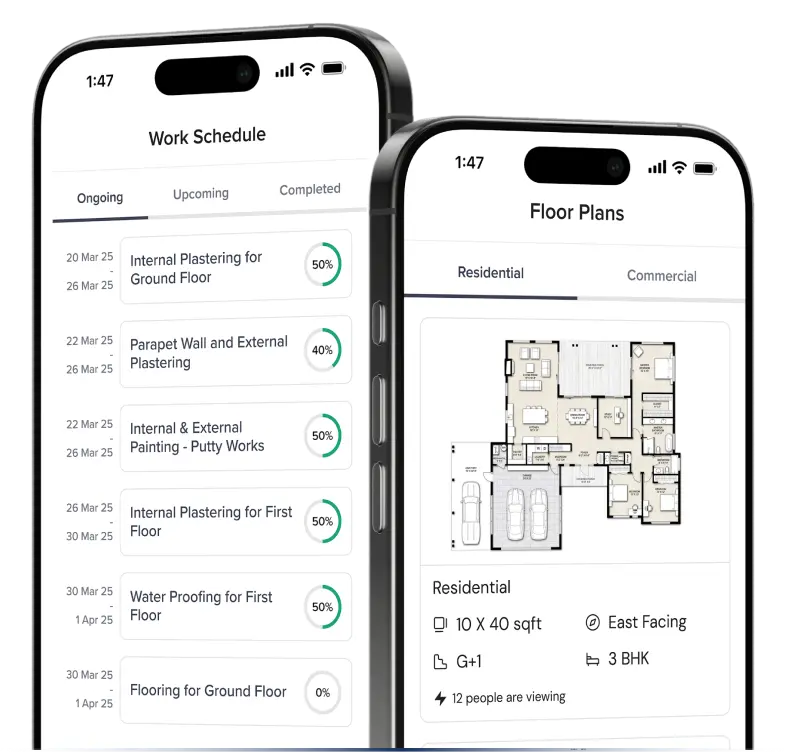
Build your home with complete transparency. Track progress, manage costs all from a single app.
- Transparent payment tracking with zero hidden costs
- Accurate cost estimation tailored to your requirements
- Real-time project tracking from start to finish
- Streamlined execution with expert coordination
- Easy design approvals directly on the app
- 3D visual tracking of construction progress
Independent House Construction Company: Complete Guide Before You Build (2026)
Building an independent house, for many families, is more than just a transaction. A decade of saving, planning and decision that shapes the daily life of generations to come.
And yet, the single variable that determines whether any of it comes together the way it was envisioned the independent house construction company often gets less scrutiny than it deserves.
This guide will definitely help all those who are planning to start building a home with a proper preparation. This guide will cover construction cost, realistic timelines of building building materials that suits well, mistakes to avoid and things to keep in mind while starting building house.
Table of Contents
- What Is an Independent House Construction Company?
- Services Offered by Independent House Builders in India
- Independent House Construction Process: Step by Step
- Independent House Construction Cost in India
- What Factors Affect the Cost of Building an Independent House in India?
- Hidden Costs of Independent House Construction
- Common Mistakes to Avoid When Building an Independent House
- Independent House Construction Timeline: What to Expect
- What Type of Independent House Can You Build on Your Plot?
- Popular Independent House Design Trends in India
- Quality Assurance in Residential Independent House Construction
- Materials Used in Independent House Construction
- Independent House Construction Cost Per Sq Ft in Major Indian Cities
- Brick & Bolt: Trusted Independent House Construction Company in India
- Milestones That Define Our Journey
- Our 6-Step Independent House Construction Process
- What Sets Brick & Bolt Apart From Other Independent House Construction Companies?
- Why Homeowners Choose Brick & Bolt for Independent House Construction
- Beyond Homes: Our Commercial Construction Services
What Is an Independent House Construction Company?
An independent house construction company is a residential construction firm that takes full ownership of building a standalone home on an individual plot, from the first design conversation to the day the keys are handed over.
The distinction from a general contractor is significant. Usually, a home contractor just executes work. Whereas, a home construction will take the responsibility of the entire process from design, engineering, approvals to execution, quality control till handover. They provide a systematic approach rather than a disconnected tasks handed off between parties.
Reliable independent house builders in India bring in a comprehensive apprach including structural engineers, vetted cintarctors, licensed architects, experienced project managers, and a systematic operational framework. This brings down significantly the effort from homeowners as the construction company will provide a trusted service where the homeowners need not approach several parties to know the progress of their home construction.
This matters more than it sounds. Most independent house construction problems in India do not originate from bad materials or unskilled labour alone. They originate from coordination failures, a structural drawing that was not updated before concrete was poured, a plumbing run that was not accounted for in the slab, a finishing team that arrived before the waterproofing had healed. A professional independent house construction company has systems to prevent these failures, not just intentions.
Services Offered by Independent House Builders in India
What a full-service independent house construction company actually delivers looks very different from what most homeowners assume when they first start the process. Here is what genuine end-to-end independent house construction services cover.
Site-Specific Architectural Design
There is a meaningful difference between a floor plan drawn for a 30×40 south-facing plot in Bangalore and one drawn for a 40×60 east-facing plot in Chennai. Custom independent house builders do not start from a library of templates and adjust the dimensions.
They will start from your site. They consider orientation, access points, neighbour’s walls.not juts that, they will also have to look at the local building rules and floor plan design to provide a complete service that works for specific conditions.
Structural Engineering Matched to Your Plot
The soil under your plot is not the same as the soil under your neighbour’s. Black cotton soil, laterite, filled land, plots near water bodies, sites in higher seismic zones — each of these demands a different structural response. A professional independent house construction company engineers the right foundation and structural system for your actual ground conditions, not the average conditions for your city.
Turnkey Independent House Construction
When a construction company takes on a project on a turnkey basis, it accepts accountability for everything — procurement, labour, quality, coordination, and schedule. The homeowner does not manage subcontractors, resolve vendor disputes, or figure out why the tile consignment is two weeks late. Turnkey house construction cost reflects this accountability and is almost always better value than managing the same complexity yourself.
Dedicated Project Management
A project manager who coordinates every trade, monitors quality, manages the schedule, and communicates clearly with the homeowner is the most undervalued element of an independent house build. Most homeowners only understand this after experiencing a build without one. By then, it is usually too late to recover the time and money lost.
Design and Build Independent House Services
The most efficient method to get a complegted independent house is a design-and-build model. Here, tye organization designs and builds your home. This method eliminates the friction between architectural intent& construction execution. There will be less cope for miscommunication between all disciplines and give homeowners a single point of accountability.
Independent House Construction Process: Step by Step
The steps to build an independent house follow a logical sequence. Each stage depends on the one before it. Skipping or compressing any step creates a problem that typically surfaces later — at greater cost and with fewer options for resolution.
Step 1: Soil Testing and Site Assessment
Before an architect draws a single line, a geotechnical engineer needs to tell you what is under the ground. Soil bearing capacity, depth of firm strata, presence of expansive soils, and water table level all determine what kind of foundation your house needs. This is not optional preparatory work. It is the technical foundation for every structural decision that follows.
Step 2: Architectural Design and Floor Plan Development
Floor planning is where the independent house construction process becomes personal. Room sizes, ceiling heights, window placements, staircase positions, kitchen orientations, the location of the pooja room, where guests arrive and where family gathers, these are not abstract design choices.
They are decisions about how your household will actually function, day after day, for decades. Spending time here, iterating, questioning assumptions, and pushing back on plans that do not feel right is one of the highest-value activities in the entire project.
Step 3: Structural Drawings and Engineering Documentation
After the architectural plan is approved, the structural engineers create the technical documentation that controls the construction process. This includes details such as reinforcement drawings, column and beam sizes, slab thickness, foundation type and depth, etc. These drawings are not bureaucratic formalities. They are the precise instructions that control whether the house stands safely for fifty years or starts developing structural issues in ten.
Step 4: Approvals and Building Permits
Every independent house construction project in India requires municipal building plan approval before the construction starts.
The documentation, fees, and timelines vary by city and local authority. A professional independent house construction company navigates this process on your behalf — so you are not learning the requirements of your local planning department while simultaneously managing design decisions.
Step 5: Foundation and Superstructure Work
This is crucial step where the project transitions from drawings to physical reality. The foundation is laid, beams and columns are cast and slabs are placed.
These are the elements that cannot be corrected after the fact at a cost that is not prohibitive. Each concrete pour should be preceded by a rebar inspection and followed by cube testing to ensure the strength of the concrete mix. This is not overcaution. This is standard procedure in any well-run residential independent house building project.
Step 6: MEP Installations
The installation of electrical conduits, plumbing lines, drainage pipes, HVAC installations, and data cables is carried out before the plastering of the walls. The quality of MEP coordination will either make your house functional and accessible or one that has been equipped with various installations that were just afterthoughts and needed constant intervention.
Step 7: Finishing, Inspection, and Handover
Plastering, flooring, painting, joinery, fixtures, external work, and final cleaning – this is the stage that is first visible to the homeowner. But finishing quality is deeply dependent on the structural and MEP quality beneath it. A structured pre-handover inspection, conducted against the original approved drawings and specifications, is the right way to close out an independent house construction project.
Independent House Construction Cost in India
The cost of constructing an independent house in India is not fixed but is rather in a range that varies depending on factors such as location, specifications, design complexity, and plot size. The following is a rough guide that can be used in early stages of planning and budgeting.
| Construction Type | Estimated Cost Per Sq Ft |
| Basic | ₹1,600 – ₹2,500 |
| Standard | ₹2,200 – ₹2,800 |
| Premium | ₹2,800 – ₹4,500+ |
These are costs for structural, standard electrical and plumbing, and finishes. Turnkey house construction costs, which include costs such as design, approval, quality supervision, top-quality finishes, and project management under one contract, will be higher than these estimates. The only estimate you can rely on for your budget is an estimate for your project, not an average.
What Factors Affect the Cost of Building an Independent House in India?
City and Micro-Location
Labour rates, contractor market conditions, material logistics costs, and approval fees do not move uniformly across India. The cost of building an independent house in Bangalore differs from an equivalent project in Hyderabad, Pune, or Mumbai — often by 15 to 25 percent on comparable specifications. Even within a city, plots in well-serviced areas near material supply chains cost less to build on than remote or poorly accessible sites.
Floors and Total Built-Up Area
Each additional floor adds not only the direct cost of that floor’s structure and finishes but also increases the loads carried by the floors below — which may require upward revision of column and beam sizes in the original structural design. A three-floor independent house is structurally more complex and more expensive per square foot than a single-floor house of equivalent total area.
Foundation Conditions
It is possible for the cost of foundation for two identical house designs built on two adjacent plots of land to vary considerably due to differences in soil profiles. Soils with low compressive strength require stronger foundations than those with good bearing capacities. This is only known through testing, not estimating or assuming.
Specification Level
The specification level across every category — structural materials, wall systems, flooring, windows, sanitary ware, kitchen fittings, external paint — cumulatively defines the independent house construction cost per sq ft. Premium independent house construction using AAC blocks, Fe500D TMT steel, full-body vitrified tiles, and high-performance external coatings costs meaningfully more than a basic-specification build. Both are legitimate choices. The important thing is that the specification is decided consciously and priced accurately before construction begins.
Supervision and Quality Infrastructure
The cost of project management with a site engineer, daily inspection logs, testing of materials in certified laboratories, and sign-offs based on project milestones is higher than an unsupervised site. On the other hand, it also provides a structurally superior building, finishes to drawing, and far fewer problems after occupancy. The cost of project management is well compensated by the avoidance of rework and maintenance.
Hidden Costs of Independent House Construction
The gap between an initial construction quote and the total cost of building an independent house in India is not accidental. It is structural built into how the industry quotes. Here is what tends to be absent from the headline number.
Pre-Construction Site Work
Plot leveling, removal of topsoil, tree cutting, construction of site fencing for security purposes, and making provisions for water and electricity connections during construction all have to be done before the foundation is poured. These costs are real, they are site-specific, and they are almost never part of any construction quote on a per-square-foot basis.
Approval and Documentation Costs
Building plan approval fees, commencement certificate charges, betterment levies, legal documentation, and professional fees for navigating the local authority approval process represent a meaningful aggregate cost — particularly in larger cities where approval infrastructure is more complex.
Professional Fees for Design and Engineering
Architectural fees and structural engineering fees are frequently quoted separately from construction execution costs. In some arrangements, even site supervision by an architect or engineer is billed separately. Every one of these line items needs to be explicitly clarified before you sign a construction contract.
External Development and Landscaping
Compound walls, gates, driveway paving, garden landscape development, external lighting installations, and rainwater management installations are all features that define the appearance and functionality of an independent house from the outside. All these features are normally excluded in the overall construction contract and are usually discovered as additional costs during the construction process.
Service Connections
Formal electricity meter installation, water supply connection, and sewage connection for a new independent house involve application and infrastructure charges levied by the relevant utility providers. These vary by city but can represent a significant addition to total project cost.
Budget planning for independent house construction should always include a 10 to 15 percent contingency on top of the full scoped project cost, not just the construction contract value.
Common Mistakes to Avoid When Building an Independent House
Most of these are decisions made before the first column is cast. That is also when they are easiest to avoid.
Evaluating Independent House Construction Contractors Only on Price
A detailed competitive quote comparison without reference checks, site visits to completed projects, and a thorough review of contract terms is an incomplete evaluation. The cheapest independent house construction contractor in a shortlist is frequently cheap because something important has been left out of the scope, the material specifications are vague, or the quality supervision model is inadequate. Find out which it is before you sign.
Starting Construction Before Drawings Are Complete
Partial drawings lead to mid-construction design decisions made under time pressure, which lead to structural compromises, coordination failures, and expensive rework. Complete architectural and structural drawings — approved by the homeowner — should be a contractual precondition for mobilisation, not an aspiration.
Treating Soil Testing as Optional
The argument against soil testing is always cost. The argument for it is always stronger — it directly informs the foundation design and can prevent a structural failure that would cost orders of magnitude more to rectify than the testing ever would.
Budgeting Only to the Construction Quote
The actual cost of building an independent house in India includes the designing costs, approvals, connections, interior finishes, external development costs, and the unexpected. The homeowner who only budgets up to the construction costs will find that they are compromising on the project in the middle or incurring unexpected debts in order to complete the house.
Conflating Finishing Quality With Structural Quality
A beautifully finished independent house can conceal poor concrete, inadequate rebar, or substandard waterproofing. Finishing quality is visible. Structural quality is not, until it becomes a problem. This is why independent stage-wise structural inspections matter so much, and why they should not be conducted by the same contractor doing the work.
Independent House Construction Timeline: What to Expect
An independent house construction project in India can take anywhere between 9 to 14 months on an average. This is includes signing off to complete handover of the hous, depending on the requirement. Of course, it may get extended if the complexity of the project increases.
Below table will help you understand in detail different stages and estimated duration of the home construction process.
| Stage | Estimated Duration |
| Soil testing and site assessment | 1–2 weeks |
| Architectural design and floor planning | 3–6 weeks |
| Structural drawings and engineering documentation | 2–4 weeks |
| Government approvals and building permits | 4–6 weeks |
| Foundation and substructure construction | 3–5 weeks |
| Superstructure (columns, beams, slabs) | 3–5 months |
| MEP installations | 4–6 weeks |
| Interior finishing and external work | 6–10 weeks |
| Pre-handover inspection and handover | 1–2 weeks |
The construction schedule for the independent house can be effectively managed if the project manager “owns” the schedule, supplier lead times are factored into the schedule from the start, and progress is monitored in real-time as opposed to reviewing progress retrospectively in milestone meetings.
What Type of Independent House Can You Build on Your Plot?
Single-Floor Ground-Level Homes
The simplest structural form and the easiest to maintain long term. Single floor independent houses are more suitable for families who need more space in the garden, or need accessibility, or are willing to compromise on the cost of construction per unit area. For sites above 2,400 sq. ft., a single floor house provides ventilated living space without any hassles of construction.
G+1 and G+2 Independent Houses
An increase in the number of floors of an independent house by one or two floors can significantly increase the floor area of the land in an urban area. With an increase in the number of floors, the complexity of the structure also increases, as the loads on the structure increase, which may also require an increase in the column sizes. The result is an efficient house in terms of land use in an urban area.
Independent Houses with Basement Levels
Basements can be added as additional floors without occupying floor area, which can be used as parking, utility rooms, home offices, or entertainment rooms. The construction of basements involves early planning, which requires waterproofing and mechanical ventilation provisions, elements that cannot be added later in the construction process. If basements are included in the project requirements, they should be planned from the very beginning.
Houses with Integrated Rental Units
A growing number of independent house construction briefs in Indian cities include a self-contained rental unit. Typically on a separate floor or in a rear portion of the plot that are designed to generate income that helps with the construction loan. Structural separation, independent metering, and dedicated entrance planning for rental units all need to be incorporated into the original design.
Compact Urban Independent Houses
For the 20×30 or 20×40 sites, the design problem is one of building an expansive home without making it sprawling. The answer lies in double-height spaces, skylights, cross-ventilation openings strategically placed, and storage design. The question is whether the architect has the ability to design an independent home that is actually livable.
Popular Independent House Design Trends in India (2026)
Courtyard-Centred Layouts
One of the traditional Indian residential building types that features a central courtyard is witnessing a significant revival in contemporary residential architecture. The central courtyard allows for natural lighting deep within the floor plan, an external space that does not depend on the boundary, and spatial qualities that are not attainable through artificial lighting.
Transition Spaces and Sit-Out Areas
The most requested spaces in the independent house designs of 2026 are covered verandas, sit-outs, and transition spaces between the inner space of the house and the garden. This is because the concept of the space is uniquely Indian, where there is a need to have morning tea, evening talks, and informal social gatherings at the threshold of going either inside or outside the house.
Climate-Responsive Passive Design
Cross ventilation, deep roof overhangs to shade windows from summer sun and yet allow winter sun in, thick walls to reduce temperature extremes inside, and windows carefully orientated to catch the prevailing breezes, are now increasingly designed in from the start, rather than as an afterthought. These solutions save energy, are comfortable, and last – they don’t become obsolescent like technology.
Rooftop Utility Integration
The rooftops of independent houses are now designed as functional spaces, rather than just structural spaces, to accommodate spaces for solar panel installations, solar water heaters, rainwater harvesting tanks, mechanical room enclosures, and in some cases, functional terraces with planters and seating spaces. It is much easier to design the rooftops for loads during the structural design stage rather than retrofitting them.
Multi-Generational Living Configurations
However, joint family living is not declining in India; it is changing. Modern houses are being planned with separate living areas for elderly parents, typically located on the ground floor and having separate bathroom facilities and sound insulation from the rest of the house. This is not easily done by adapting an existing bedroom and requires serious planning during the floor plan stages of the project.
Low-Maintenance Exterior Finishes
Textured cement finishes, brick feature walls, stone claddings, and premium quality textured exterior paints are becoming popular alternatives to smooth render finishes in independent house designs. The underlying reason is purely functional: finishes that do not weather, stain, or peel in three monsoon cycles are an improvement in quality of life.
Quality Assurance in Residential Independent House Construction
The structural quality of an independent house is established in the first half of the construction timeline, during foundation work, column casting, and slab pours. The finishing quality is visible in the second half. Most quality failures that surface post-occupation originate in the first half and are concealed by the second.
A rigorous quality assurance system for independent house construction should cover soil test review before foundation design is finalised, rebar inspection against structural drawings before every concrete pour, concrete mix design verification and cube testing at 7-day and 28-day intervals, waterproofing membrane inspection before screed and finishing layers are applied, MEP pressure and continuity testing before wall plastering, plumb and level checks on masonry at each floor level, and a structured pre-handover inspection conducted against original approved drawings — not against what was built and then described as built.
The difference between the quality system and the quality intention is documentation. Documentation of each inspection should be done in the form of a document that is signed and indicates what was inspected, who inspected it, what was found, and what was required to be done about it. This is the documentation that the homeowner needs in order to prove what was paid for and what was provided.
Materials Used in Independent House Construction
The material choices made during independent house construction have consequences that play out over decades, not months. Here is what each key material does and why the specification decision matters.
Cement Grade and Quality
OPC 53 grade cement produces higher early strength and is appropriate for structural concrete in columns, beams, and slabs. PPC cement, which incorporates fly ash, offers better long-term durability and reduced heat of hydration — making it well-suited for foundations and mass concrete applications. Using the right cement type for each application is a detail that distinguishes technically competent independent house construction from generic execution.
TMT Reinforcement Steel
Fe500D TMT bars — the D designation indicating higher ductility — are the minimum appropriate specification for reinforced concrete structural elements in independent house construction in seismic zones. Higher ductility means the structure can absorb and distribute seismic energy without brittle fracture. This is not a premium specification choice. It is a safety specification choice.
Wall Construction Systems
The conventional red clay bricks, fly ash bricks, and AAC blocks have their own performance profiles. The conventional red clay bricks are well known, whereas fly ash bricks possess higher compressive strength with lower water absorption. AAC blocks offer higher thermal efficiency, along with significantly lower weight of the wall, which can allow optimization of column and beam sizes downward. The best option would depend on your place, climate, and structural design of your house.
Waterproofing and Moisture Management
There is no such thing as a waterproofing product for an independent house. There is a waterproofing system. The various parts of the house require different types of waterproofing. For instance, crystalline waterproofing compounds are used in the concrete of the foundations, polymer-modified cement-based coatings are used in bathrooms and wet areas, torch-on or self-adhesive membrane systems are used in the roof slabs of the house, and elastomeric membrane coatings are used on the external walls. Each of these requires different surface treatments and curing methods. This requires supervision by someone who is familiar with these details and not just the contractor who applies the product that is most readily available.
Window and Door Frames
The frame system of the independent house is the most important factor that affects the performance of the building in terms of thermal performance, acoustic insulation, maintenance intervals, and weather tightness. The thermally broken aluminum sections with double glazing give the best performance in all the parameters for most of the Indian climate conditions. UPVC sections are the best replacement for aluminum sections in high humidity conditions along the coasts. Single glazing of aluminum sections, which are most commonly used for the construction of independent houses because of low costs, have low performance.
External Finishes and Protective Coatings
The external surface of an independent house is exposed to UV radiation, monsoon moisture, temperature variations, and biological growth during its lifetime. Textured masonry paint with waterproofing properties is considered to be the first line of defense in resisting the ingress of moisture through the external walls of buildings. The lifespan of such protection before repainting is required depends upon the quality of paint used and its surface preparation.
Independent House Construction Cost Per Sq Ft in Major Indian Cities
The following table has the breakdown of the current market conditions for independent house construction across major cities. This can help you with thenearly-stage budgeting and contract negotiations.
| City | Basic (₹/sq ft) | Standard (₹/sq ft) | Premium (₹/sq ft) |
| Bangalore | ₹1,600–2,000 | ₹2,000–2,800 | ₹2,800–4,000 |
| Chennai | ₹1,800–2,200 | ₹2,200–3,000 | ₹3,000–4,500 |
| Hyderabad | ₹1,700–2,250 | ₹2,250–2,900 | ₹2,900–3,800 |
| Mumbai | ₹2,500–3,000 | ₹3,000–4,500 | ₹5,000–7,500 |
| Pune | ₹1,800–2,400 | ₹2,400–3,200 | ₹3,200–4,500 |
| Delhi NCR | ₹1,800–2,500 | ₹2,500–4,500 | ₹4,500–10,000+ |
| Coimbatore | ₹1,750–2,200 | ₹2,200–2,800 | ₹2,800–3,500 |
| Kochi | ₹1,700–2,300 | ₹2,300–3,000 | ₹3,000–4,000 |
| Ahmedabad | ₹1,400–1,900 | ₹1,900–2,750 | ₹2,750–3,500 |
| Kolkata | ₹1,600–2,100 | ₹2,100–2,800 | ₹2,800–3,800 |
| Noida | ₹1,700–2,400 | ₹2,400–3,100 | ₹3,100–4,000 |
| Ghaziabad | ₹1,600–2,300 | ₹2,300–3,000 | ₹3,000–3,800 |
Note: These figures are indicative only. The independent house construction cist per sq ft for your project depends on the plot size, structural requirements, design complexity, and finishing.
Brick & Bolt: Trusted Independent House Construction Company in India
The conventional model for building an independent house in India distributes risk entirely to the homeowner. The contractor takes a margin and manages labour. The architect manages drawings. The structural engineer manages calculations. Nobody manages the system, and the homeowner, who has no professional construction experience, is left to hold it together.
Brick & Bolt was built to change that. We are technology-driven independent house construction company operating across Bangalore, Chennai, Hyderabad, Pune, Mumbai, Delhi NCR, Kochi, Coimbatore, Kolkata, Ahmedabad, Noida, Ghaziabad, and other major Indian cities. Brick & Bolt, offers end-to-end services including design, engineering, procurement, execution, quality and handover under a systematic structure.
We have delivered over 9000 residential projects since 2018 across major Indian cities using this structure. The results are consistent because the process is consistent across.
Milestones That Define Our Journey
| Date | Milestone |
| January 2018 | Founded in Bangalore |
| October 2019 | Pre-Series A (Sequoia Capital) |
| August 2020 | Series A (Foundamental) |
| April 2021 | 1,500+ projects completed |
| December 2022 | 2,100+ projects completed |
| January 2024 | 4,500+ projects completed |
| November 2024 | 7,000+ projects completed |
| July 2025 | 9,000+ projects and growing |
These are not marketing milestones. Each number represents a family who placed an enormous amount of trust in Brick & Bolt — and received an independent house that justified it.
Our 6-Step Independent House Construction Process
The Brick & Bolt process is designed to give homeowners complete clarity at every stage — not just at the beginning and at handover, but throughout.
Step 1: Connect With Our Experts
First step starts with understanding your requirements and not just selling the packages. Our residential specialist get a better idea on the plot size, area, budget etc.
Step 2: Define Your Requirements
Dimensions, orientation, number of floors, room programme, Vastu requirements, budget, and lifestyle considerations are all documented, which form the brief for architectural and structural design.
Step 3: Finalise Cost and Timeline
A detailed cost breakdown of the entire project, including the construction cost of a house, construction cost of a house per sq. ft., contract value of the entire project, and payment milestones, as well as a construction timeline, are provided before the construction even begins. Everything is defined, and nothing is left open-ended.
Step 4: Review and Approve Designs
The floor plans, elevations, sections, and structural drawings are reviewed in detail with you. Changes are made to arrive at a design that accurately represents your brief. This process is complete only when you are satisfied, because any unsatisfactory design decisions made here become permanent structural realities in the construction process.
Step 5: Track Progress in Real Time
Brick & Bolt’s technology platform gives you live access to construction milestone progress, quality inspection records, material delivery confirmations, and payment utilisation — from wherever you are. No calls to find out what is happening on site. No updates when the contractor has good news. Continuous, objective visibility.
Step 6: Move Into Your New Home
A handover is a formal process and is certainly not a walkthrough. Every quality checkpoint is documented, every system is tested, and every finish is verified against the specifications. You are moving into a completed home and not into a project that needs resolution.
What Sets Brick & Bolt Apart From Other Independent House Construction Companies?
QASCON : 470+ Quality Checkpoints Across the Full Build
Most construction companies check quality at handover. Brick & Bolt’s proprietary QASCON® system checks quality throughout — at more than 470 documented stage-wise checkpoints covering structural work, materials, MEP installations, and finishing. Problems are caught when they can still be fixed easily, not after they have been plastered over.
VISE Design Methodology
VISE structures every independent house design around four non-negotiable principles: Vastu compliance, indoor environment quality, space utilisation that produces genuinely livable homes, and ergonomic planning. The result is houses that are planned for how Indian families actually live — not for how floor plans look in a brochure.
BIM-Enabled Planning
Building Information Modeling means your independent house exists as a fully detailed digital model before it exists as a physical building. You see the finished home before construction begins. Structural, architectural, and MEP systems are coordinated in the model before they are coordinated on site. Surprises are designed out, not managed in the field.
Why Homeowners Choose Brick & Bolt for Independent House Construction
No Ambiguity on Cost
The project cost is defined before construction begins and tracked against that definition throughout. Every variation is documented and approved before it is executed. There are no post-completion invoices for work that was assumed to be included.
Payment Tied to Verified Progress
Brick & Bolt’s escrow-based milestone payment system releases funds only when construction milestones are independently verified as complete. Homeowners pay for work that has been done and confirmed — not for work that has been promised.
Engineering Supervision, Not Just Contractor Management
Quality inspections at Brick & Bolt are conducted by qualified engineers, not by the construction team that did the work. That independence is what makes the inspection meaningful.
Deadlines That Are Met
Brick & Bolt’s project management infrastructure — scheduling tools, real-time tracking, proactive coordination — is designed to deliver projects on the agreed timeline. On-time completion is not a target. It is an operational standard.
Full Visibility, Always
The technology platform that underpins every Brick & Bolt independent house construction project gives homeowners access to their build status, quality records, cost utilisation, and milestone progress at any time — from any device.
Beyond Homes: Our Commercial Construction Services
The same operational discipline that governs every independent house construction project at Brick & Bolt is applied across a full range of commercial construction services like, offices, retail showrooms, warehouses, educational campuses, hospitality developments, and healthcare facilities across India.
Transparent contracts, BIM-enabled design and planning, engineering-led quality monitoring, and milestone-based payment structures are not residential-only capabilities. They are how Brick & Bolt builds — regardless of the project type. Commercial clients receive the same cost clarity, schedule accountability, and structural quality that have made Brick & Bolt one of the most trusted names in Indian residential construction.
FAQs on Independent House Construction: Cost, Process & Builder Guide
• Cost to build a house in India: ₹1,300–₹3,500 per sq ft
• Timeline: 6–12 months
• Best option: Turnkey construction
• Key factors: Location, materials, labor, design
• Budget tip: Keep 18–25% contingency